Quick answer
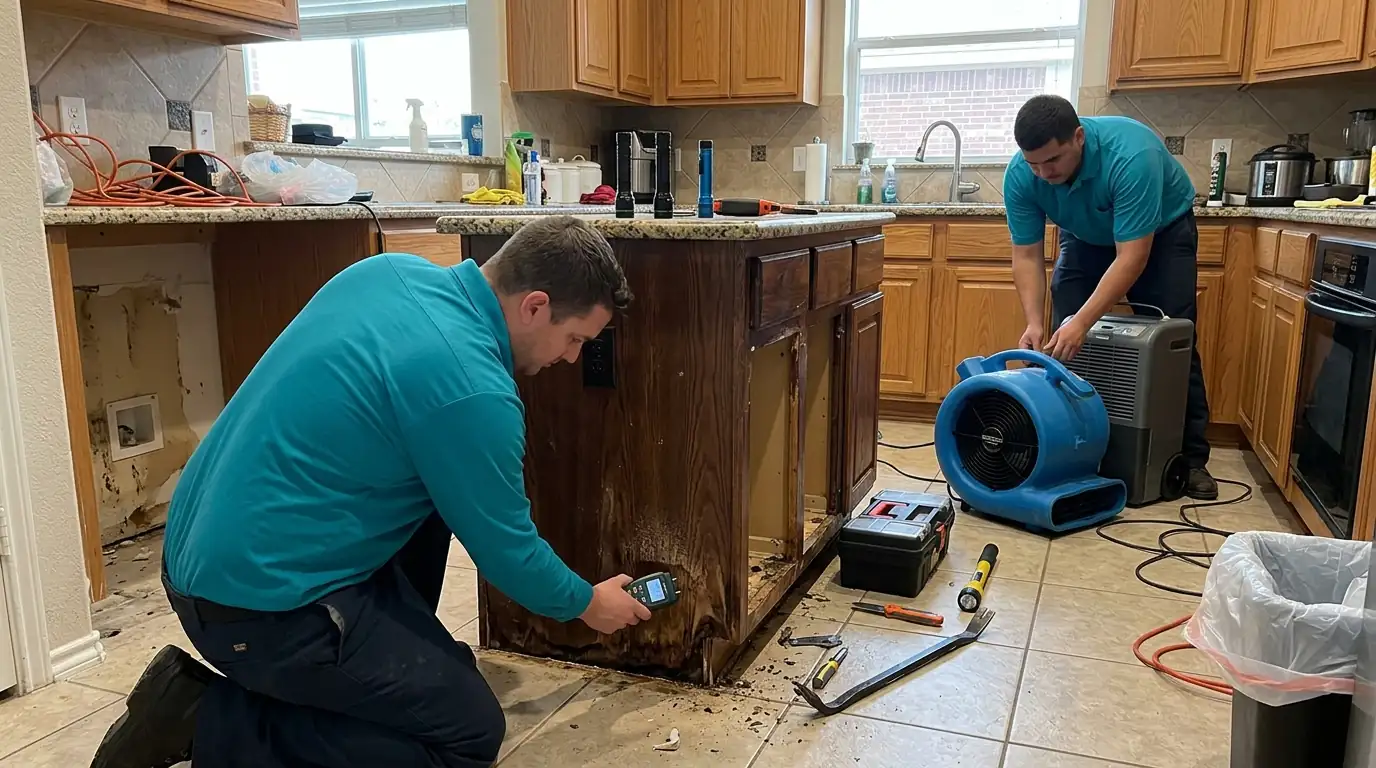
Water-damaged cabinet repair in Fort Worth means drying behind and under the cabinet, not just the box you can see, because particleboard swells within hours of soaking and holds water against the wall. We pull toe-kicks and back panels, read the wall and floor, dry the cavity, then repair the cabinet or replace the damaged boxes.
What Water-Damaged Cabinet Repair Involves
Kitchen and bathroom cabinets sit right where leaks start: under sinks, next to dishwashers and ice makers, and beside water heaters and washing machines. Most modern cabinet boxes are particleboard or MDF with a thin finish, and once water reaches the raw edges, they swell and crumble. The bigger problem is out of sight. Water runs behind the cabinet and under the toe-kick, where the drywall and floor stay wet because no air reaches them.
We start by finding where the water went. That often means removing the toe-kick, cutting an access hole in the cabinet back or pulling the cabinet off the wall. If the floor under the cabinets is wet, flooring replacement may be part of the repair, and if the wall behind is soaked, drywall repair follows the drying. Cabinets that only got damp may be saved. Cabinets that swelled usually can't.
Sink Base Cabinets
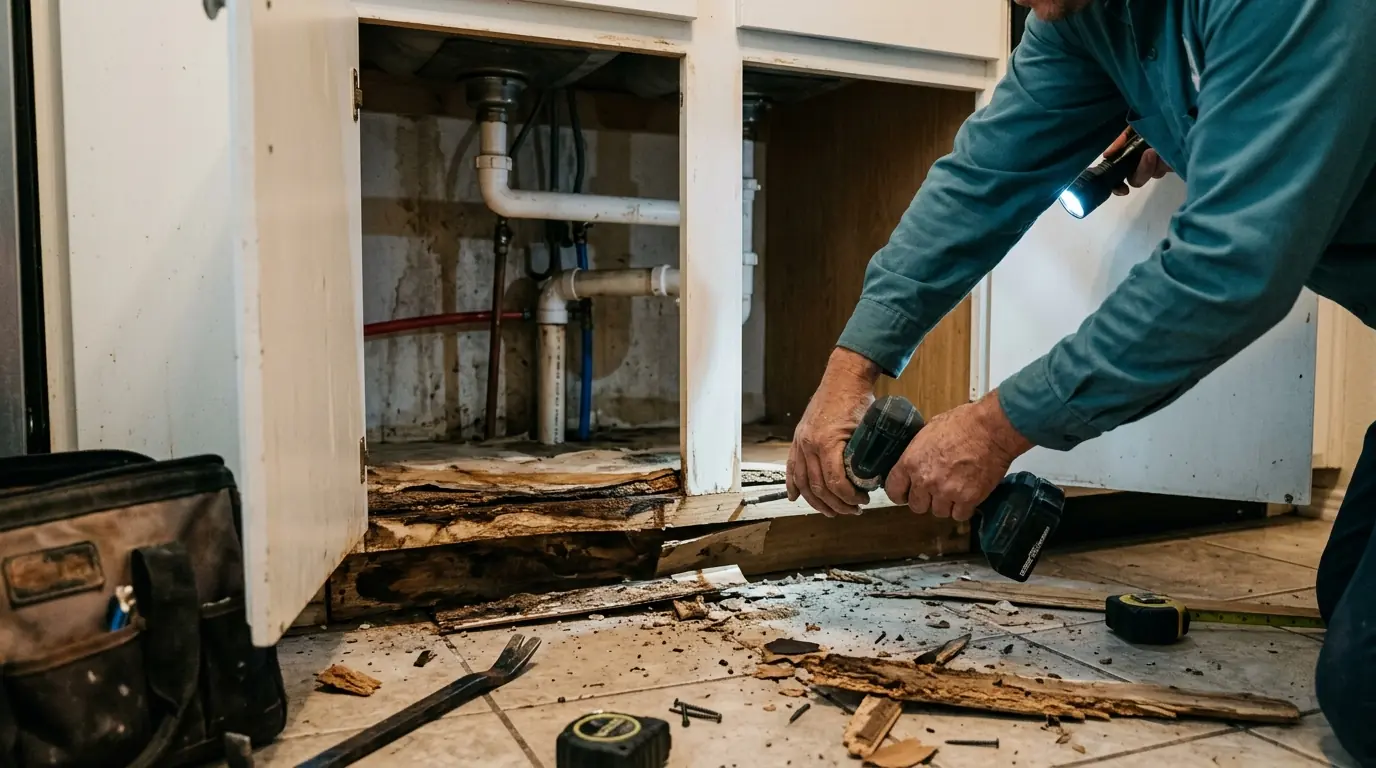
Sink bases take the most leaks: a loose trap, a failed supply line, a dripping disposal or a cracked faucet base. The cabinet floor swells into a hump, the finish peels, and you may smell something musty when you open the doors. We remove what's stored inside, check the plumbing connections for the source and read the cabinet floor, back panel and wall behind it. A swollen cabinet floor can often be cut out and replaced with a new panel while the box stays. Cost depends on whether the sides and face frame swelled too, or only the floor.
Toe-Kicks and the Subfloor Below
The toe-kick is the recessed strip along the bottom of the cabinets, and the space behind it is where water hides. A dishwasher or fridge line leak can run under a whole row of cabinets without showing anywhere. Signs include a swollen toe-kick, flooring lifting at the cabinet edge, or a smell near the floor. We pull the toe-kick, read the floor and the cavity behind it, and blow dry air through the space or drill small holes to vent it. If the subfloor or slab is wet deep under the cabinets, the cabinets may have to come out to dry it.
Cabinet Replacement
When the sides, back or face frame of a cabinet box have swollen or delaminated, repair stops making sense. Particleboard that has puffed up won't shrink back, and it won't hold screws well again. We disconnect plumbing and appliances, protect the countertop if it can be reused, remove the damaged boxes and dry the wall and floor behind them. New boxes go in, the countertop is reset and connections are restored. Cost depends on how many boxes need replacing, whether the countertop survives removal, and how closely the new doors need to match the old ones.
Repair the Cabinet or Replace the Box?
| Factor | Dry and repair in place | Replace the cabinet box |
|---|---|---|
| Best fit | Damp cabinet, swelling limited to the floor panel | Sides, back or face frame swollen or crumbling |
| Countertop | Stays in place | Lifted and reset, with some risk of cracking stone |
| Matching | Original doors and finish stay | New boxes and doors need to match the rest of the room |
| Access to the wall | Through toe-kick and back-panel openings | Full access to dry and inspect wall and floor |
| Time out of the kitchen | Shorter, often days | Longer, depends on ordering cabinets |
If only the cabinet floor swelled and the box still holds screws firmly, repair in place; if the side panels have swollen, replacement is usually the better spend.
Smoke, Soot or Water Damage Tonight?
The line is answered around the clock. Tell us what you see and we will tell you what to do first.
What Decides the Cost of Cabinet Water Damage Repair?
None of the published cost sources we use covers cabinet repair after a leak, so we won't give a dollar figure. Cost here depends on whether the boxes can be repaired or must be replaced, and on what's hidden behind them. These are the main factors.
- Repair vs replacementReplacing a swollen cabinet floor is a small job. Replacing whole boxes means removing countertops, disconnecting plumbing and installing new units.
- Number of boxes affectedA single sink base is far less work than a run of cabinets along a wall where water spread under all of them.
- Countertop conditionStone tops can sometimes be lifted and reused, but they can crack during removal, which adds a replacement to the job.
- Matching doors and finishStock cabinets are easier to match. Custom or older cabinets may need doors refinished or replaced across the room for a consistent look.
- Wall and floor behindWet drywall, subfloor or flooring under the cabinets adds drying time and its own repairs before new boxes can go in.
Every job is priced after we see the damage and take readings; these factors explain why two jobs that look alike can cost very different amounts.
Cabinets in Newer and Older Homes West and South of Fort Worth
Fort Worth field note
The houses we see range widely in age, and cabinet repair changes with them. Midlothian's housing units nearly doubled from 6,138 in 2010 to 11,978 in 2020, and kitchens from a building boom like that often use factory-made boxes where a single damaged unit can be swapped out. In Weatherford, several Queen Anne and Victorian homes were built around the turn of the 20th century, and cabinets in houses that old may be original or custom-built. Those are harder to match, so we try harder to dry and repair them in place.
How We Handle Water-Damaged Cabinets
- 01
Find the source
We check supply lines, drain connections, the dishwasher and the ice maker line, and confirm the leak is stopped before anything else, because drying a cabinet that's still leaking goes nowhere.
- 02
Open the hidden spaces
Toe-kicks come off and, where needed, we cut small access openings in cabinet backs, so we can read moisture in the wall and floor and reach those spaces with dry air.
- 03
Dry behind and below
Air movers and dehumidifiers push dry air into the cavities behind and under the cabinets. If readings don't drop because air can't reach, the cabinet comes out.
- 04
Repair or replace
We replace swollen cabinet floors and panels where the box is still sound and holds screws, or install new boxes where the sides and frame have swollen.
- 05
Reset and reconnect
Countertops, toe-kicks, doors and hardware go back on, then plumbing and appliances are reconnected and run while we watch the connections for any sign of a leak.
Signs Water Got Into Your Cabinets
A hump in the cabinet floor
Particleboard swells into a bulge when it absorbs water, most often in the sink base right below the trap or supply lines.
Peeling or bubbling finish
The thin laminate or paint on cabinet panels lifts away from the core when moisture reaches it from behind or below.
Musty smell when you open the doors
A damp, earthy smell inside a cabinet often means water is trapped behind the back panel or under the cabinet floor.
Swollen or loose toe-kick
A toe-kick that bows out or comes loose is often wet from water running under the cabinet run.
Flooring lifting at the cabinet edge
Laminate or vinyl that curls up along the base of the cabinets points to water spreading underneath them.
Water-Damaged Cabinet Repair Questions From Fort Worth Homeowners
No. Once particleboard swells, the bond between its wood chips is broken, and it stays thicker and weaker even after it dries. The swollen panel has to be cut out and replaced. If only the cabinet floor is affected, a new panel can often go in without removing the whole box.
Often, yes, because the countertop rests on the cabinet and is fastened to it. Laminate tops usually come off easily. Stone tops can sometimes be supported in place while the box under them is swapped, but if removal is needed, there's a risk of cracking, which we discuss before starting.
Dishwasher leaks often run sideways under the neighboring cabinets, and the toe-kick blocks air from reaching that space. Pulling it lets us read the floor under the cabinets and push dry air into the cavity. Without it, water can sit there for weeks.
Sometimes. Stock cabinet lines often still sell the same door style. Custom or older cabinets are harder, and paint or stain colors fade over time. If we can't find a close match, refinishing the doors on that wall is often the cleanest option.
Yes, if it's safe. Take out cleaning products, trash cans and anything stored inside, and set wet items aside to dry or discard. Leave the plumbing alone once the water is shut off. An empty cabinet lets us read and photograph the damage right away.
Related Work We Handle
Find Out If Your Cabinets Can Be Saved
The cabinet you can see is often fine; the wall and floor behind it are the question. Tell us which cabinet got wet and what leaked, and we'll read what's hidden and plan the repair. Call us now.
Updated October 2026