Fairmount, Fort Worth, TX
Water and Fire Damage Repair for Fairmount's Historic Homes
Phones answered 24/7 for Fairmount homes and businesses.
Quick answer
Water and fire damage repair in Fairmount means working on wood-frame bungalows built mostly between 1905 and 1920. Many of these houses sit on pier-and-beam over crawl spaces, so a leak drops water under the floor rather than across it, and old dry framing lets a small fire spread quickly.
Restoration Work Around Fairmount
In Fort Worth's Fairmount, nearly every call involves an older house with original materials: shiplap or plaster walls, longleaf pine or oak floors over joists and dirt crawl spaces. Water that leaks through the floor collects underneath and keeps the joists wet. We pump the crawl space, pull wet insulation and dry the wood from below while drying the floor from above.
Fire in an older frame house can behave differently from fire in a modern one. Where a bungalow has open stud bays, heat and smoke climb from the first floor to the attic, and old wood burns fast. After the fire is out, firefighting water sits in the crawl space and the wall cavities. We handle board-up, soot removal, drying and deodorizing, deciding on original trim and floors piece by piece.
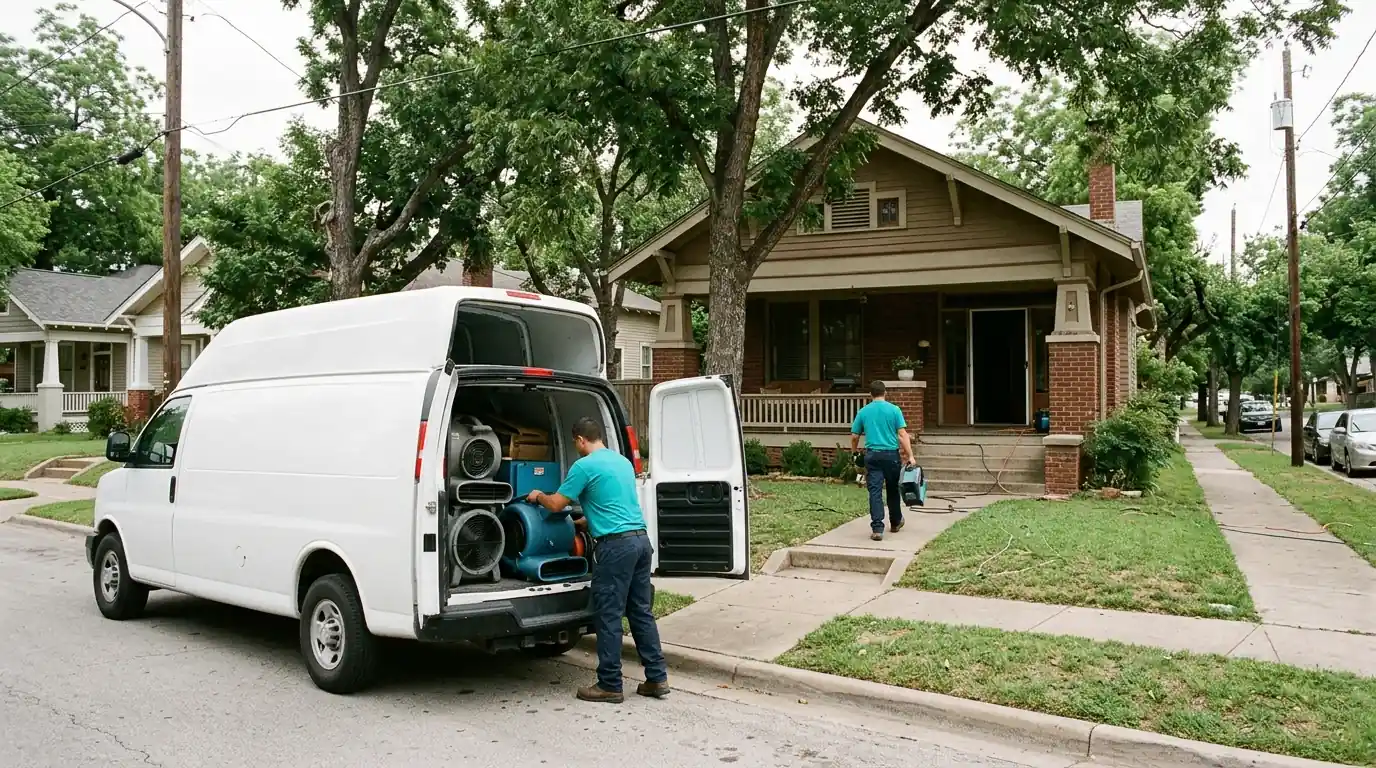
Why Fairmount Bungalows Hold Water Under the Floor
Fairmount and the wider Southside cover about 375 acres two miles south of downtown, built from 1890 to 1938, mostly between 1905 and 1920. Wood-frame bungalows are the most common house type. Those homes sit on piers above crawl spaces that collect whatever water gets past the floor. A washing machine overflow or a burst supply line under the kitchen soaks the subfloor, then drips into the dirt below. Without pumping the water and running dehumidifiers underneath, the joists stay wet for weeks and mold settles on the wood near the sill.
Hail Roofs After the 2016 St. Patrick's Day Storm
After the March 17, 2016 hailstorm, many homes in Fairmount needed new roofs. That storm was described as a $600 million day of hail damage across Tarrant County. Older roofs on steep bungalow pitches took heavy hits that day, and leaks found their way into attics with little or no insulation, straight onto plaster or beadboard ceilings. Plaster can often be dried in place if the keys hold, while beadboard needs slow, careful drying to avoid warping. We check every hail-affected ceiling before deciding what stays and what gets replaced.
Calls We Get From Fairmount
How a Call From Fairmount Runs
We answer Fairmount calls 24/7. We ask whether the leak or fire reached the crawl space, what the walls are made of, and whether trim, floors or built-ins are at risk. We bring pumps for under the floor, extractors, dehumidifiers, floor drying mats and soot cleaning gear, photographing originals first.
Fairmount Restoration Questions
Often, if drying starts soon. Old-growth pine is dense and stable, so boards that crowned slightly tend to settle back as moisture leaves. We use floor mats above and dehumidifiers in the crawl space, and replace split boards with matching reclaimed wood.
They can. When stud bays run open from the foundation toward the roof, heat and smoke travel up quickly. After a fire, we check cavities on every floor, not just the room where it started, because soot and odor collect high in the walls.
Yes. We pump out standing water, haul out sagging insulation and any ripped plastic sheeting, then set dehumidifiers and air movers under the house. The floor above dries from below, and we only lift boards if readings stay high in one spot.
Not unless the plaster has separated from the lath. Plaster holds up to water better than drywall and can usually be dried in place, and swapping it out changes the character of a historic Fairmount home.
Nearby Areas We Cover
Water, Fire or Storm Damage in Fairmount?
Tell us what happened and where the water or smoke went. We will walk you through the first steps on the phone.
Updated October 2026