Ellis County, TX
Water and Mold Damage Cleanup in Ellis County
Phones answered 24/7 for Ellis County homes and businesses.
Quick answer
Water and mold damage cleanup in Ellis County comes down to clay. The county sits on Blackland Prairie with marly clays that hold moisture against slabs and wall bottoms, so a leak that seems small can keep drywall damp long enough for mold to start within 24 to 48 hours.
Restoration Work Around Ellis County
Ellis County grew from about 150,000 residents in 2010 to more than 192,000 in 2020, and much of that growth arrived as slab-on-grade subdivisions. Newer homes are tight, which saves energy but traps humidity after a leak. A dripping supply line behind a vanity can keep the bottom of a wall wet for weeks, and by the time paint bubbles, mold is often on the back of the drywall.
We handle the remediation side: containment with plastic and negative air, removal of affected drywall and insulation, HEPA vacuuming, antimicrobial treatment and drying. For larger jobs, Texas splits the work in two, and an independent assessor writes the protocol and checks clearance. We follow it and document each step. For leaks caught early, mold prevention after water damage is often enough.
Why Marly Blackland Clay Keeps Walls Wet
Ellis County lies on Blackland Prairie, and its soils are mostly calcareous, marly clays and clay loams, with clay alluvium along the streams. Clay swells when it's wet and drains slowly, so after a long rain the ground around a slab stays saturated. That keeps the concrete and the bottom plates of walls cool and damp. Add a leak inside the house and drying slows down. We set dehumidifiers to pull the air dry, open the bottom of the wall where readings stay high, and check the slab before new flooring goes down.
Creeks and Joe Pool Lake on the County's Wet Side
The Trinity River forms the eastern boundary. Red Oak and Waxahachie creeks drain much of the county, and Mountain Creek drains the northwest. Joe Pool Lake was finished in December 1985 for flood control on the Mountain Creek and Walnut Creek watershed. It straddles three counties, including this one. When those creeks rise after heavy spring storms, low homes near the channels can take muddy water into garages and living rooms. Overflow water counts as contaminated, so carpet, flooring and drywall it touched usually come out before any drying starts.
Calls We Get From Ellis County
How a Call From Ellis County Runs
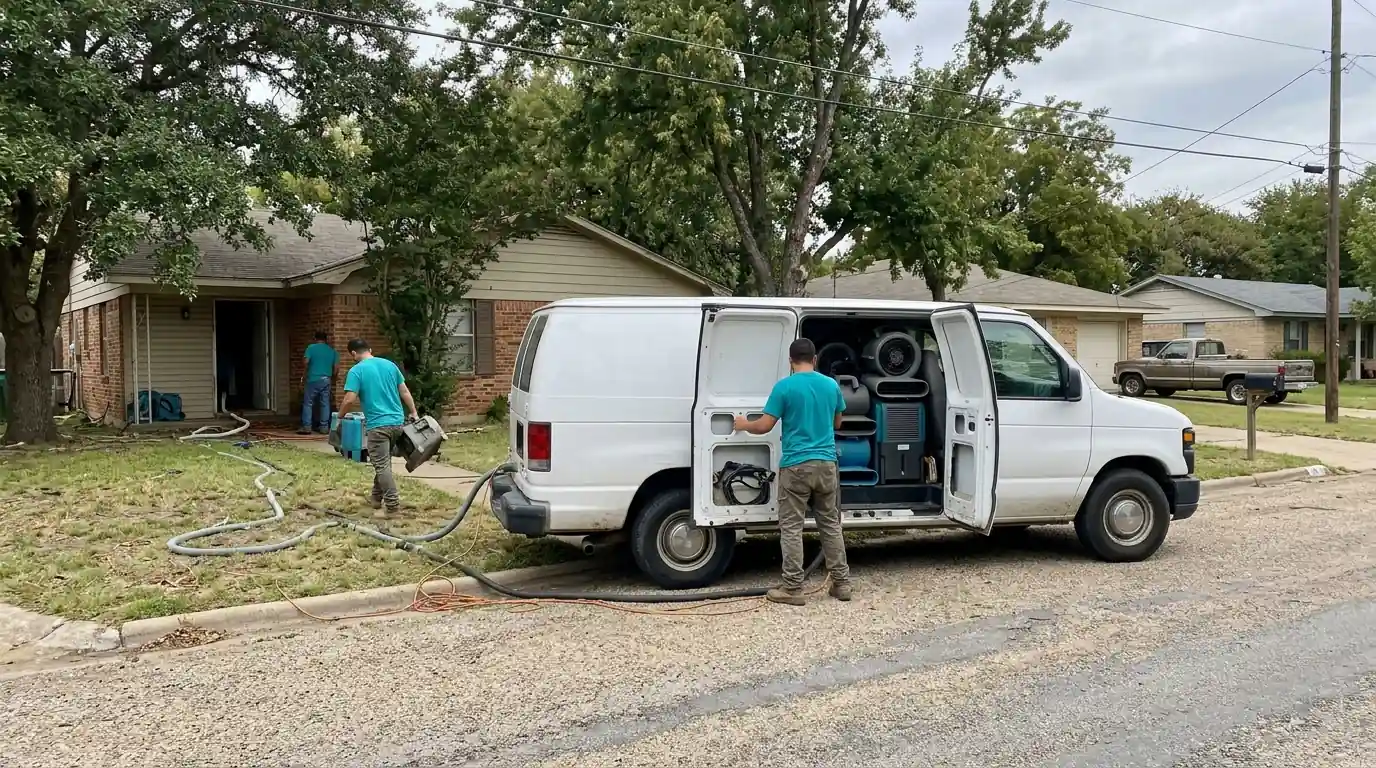
Ellis County calls get the same first questions: what got wet, how long it has likely been wet, and whether you see or smell mold. We answer 24/7. If there's visible growth, containment goes up before anything else moves. We carry plastic sheeting, a negative air machine, HEPA vacuums, moisture meters and dehumidifiers, and photograph everything first.
Ellis County Restoration Questions
Texas lets anyone clean visible mold covering under 25 contiguous square feet without a state mold license. For a patch that size on a hard surface, cleaning and drying can work. If it returns or sits inside a wall, find the moisture source first.
On larger jobs in Texas, an independent mold assessment consultant writes the protocol and runs the clearance assessment afterward. The company doing the removal cannot assess the same project. After clearance, a Certificate of Mold Damage Remediation is issued.
Not by itself. Mold needs ongoing moisture inside the house. A creek overflow that soaks flooring and drywall can supply it for weeks, so prompt removal of wet porous materials and thorough drying matter most here.
A musty smell after a leak usually means water is still in the cabinet base, subfloor or wall. We meter the cabinets and wall, remove the toe-kick if needed, and dry the cavity before mold settles in.
Nearby Areas We Cover
Water, Fire or Storm Damage in Ellis County?
Tell us what happened and where the water or smoke went. We will walk you through the first steps on the phone.
Updated October 2026