Benbrook, TX
Storm and Water Damage Repair for Benbrook Homes
Phones answered 24/7 for Benbrook homes and businesses.
Quick answer
Storm and water damage repair in Benbrook mostly involves homes from the city's growth between 1960 and 1980, when it went from about 3,000 to over 13,000 residents. Those houses now have roofs replaced more than once and plumbing old enough that supply lines and water heaters fail.
Restoration Work Around Benbrook
Benbrook sits next to Benbrook Lake on Fort Worth's southwest side. Most of its homes went up in the 1960s and 1970s, on slabs with brick veneer and wood framing. Their supply lines, drain lines and water heaters have aged, and roofs here take the same spring hail and wind as the rest of Tarrant County. Both kinds of damage end up in the same rooms.
Storm calls usually begin with a roof opening and water in the attic. We tarp, pull wet insulation, check decking and dry the framing. Water heaters and supply lines account for most of the indoor losses, soaking carpet and drywall in hallways and closets. When a water heater lets go, appliance leak cleanup covers extraction plus the cabinet and wall drying that follows.
Benbrook Lake and the Floods It Held Back
Benbrook Dam construction began in May 1947, and Benbrook Lake formed in 1952. The lake has helped prevent flood damage downstream on the Clear Fork of the Trinity in 1957, 1989, 1990 and 1991. For homeowners in Benbrook itself, that history means rising floodwater is rarely the cause of a call. Our water work here centers on what happens inside: failed water heaters, burst supply lines and roof leaks after storms. Heavy rain can still overwhelm a gutter or a low patio and push water under a door, and that runoff gets handled as contaminated water.
Houses From Benbrook's 1960s and 1970s Growth
Benbrook grew from 3,254 residents in 1960 to 13,579 in 1980. Homes from those two decades usually have copper or galvanized supply lines, cast iron drains and water heaters in garages or interior closets. Many original heaters have been replaced, but the closets around them may hide old water damage. When a heater tank rusts through, water runs across slab floors into nearby rooms. Carpet pad in the hallway usually soaks first. We extract it, check the wall bottoms and cabinets nearby, and dry the whole area before mold has a chance to start.
Calls We Get From Benbrook
How a Call From Benbrook Runs
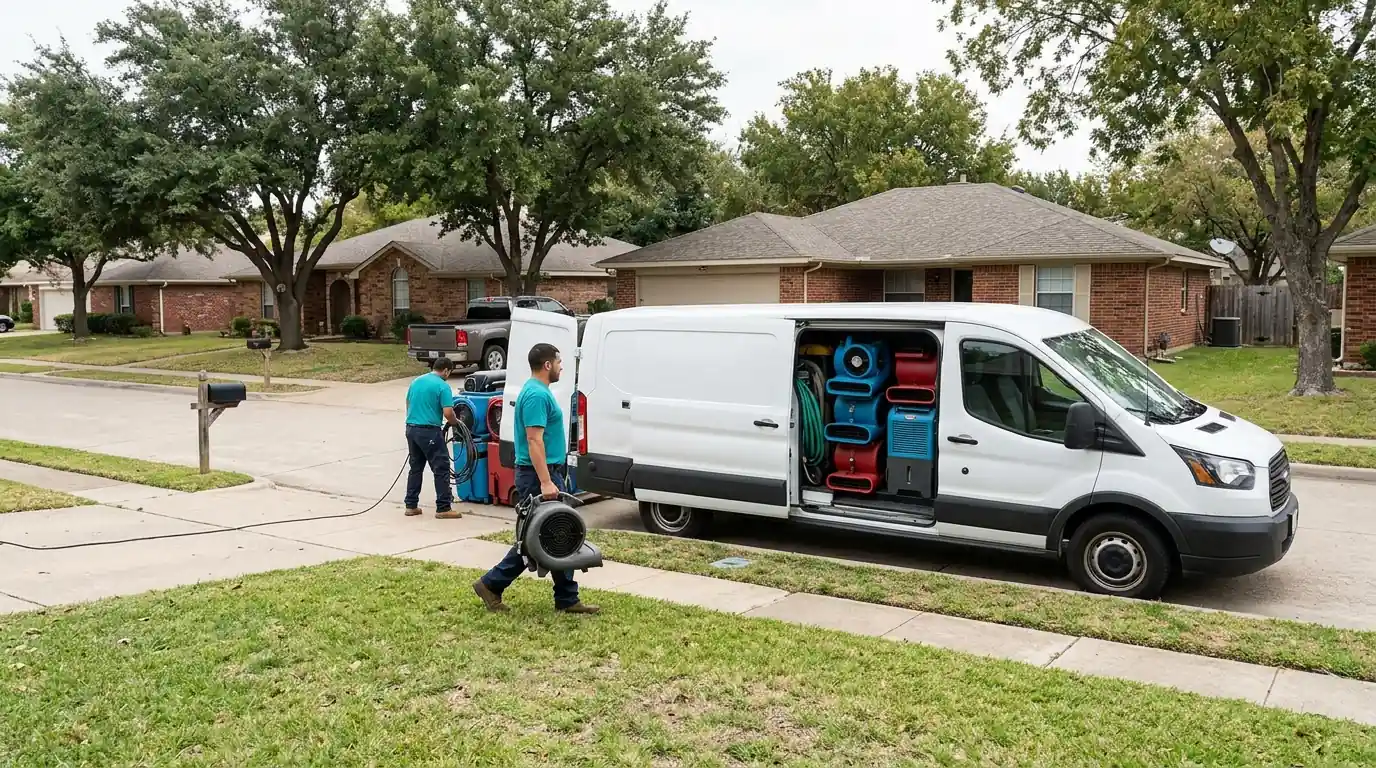
We answer Benbrook calls day and night. We ask whether water is still flowing, whether you've shut off the heater or main, and how far it spread. We arrive with extractors, carpet drying equipment, moisture meters, air movers and dehumidifiers. For roof leaks, tarps come along and we check the attic before setting equipment in the rooms below.
Benbrook Restoration Questions
Turn off the cold water supply valve on top of the heater. For a gas unit, turn the gas valve to off. For electric, flip the breaker. Then call us to extract the water and check the floor and walls around it.
The lake was built for flood control and has helped prevent downstream flooding several times. Most water damage we see in Benbrook comes from plumbing, appliances and roof leaks rather than the lake, though runoff from heavy rain can still reach low doors.
A soft floor around a water heater usually means a slow leak has soaked the subfloor or the base of the closet walls. On a slab, it may be the flooring itself. We meter the area and check whether mold has started.
Yes. Water can soak attic insulation and run along rafters for weeks before a stain shows on the ceiling. After a storm, checking the attic for damp insulation or water marks catches problems while the repair is still small.
Nearby Areas We Cover
Water, Fire or Storm Damage in Benbrook?
Tell us what happened and where the water or smoke went. We will walk you through the first steps on the phone.
Updated October 2026