Johnson County, TX
Water Damage and Storm Cleanup Throughout Johnson County
Phones answered 24/7 for Johnson County homes and businesses.
Quick answer
Water damage and storm cleanup in Johnson County means planning for wind as much as water. On one April 2022 storm night, four of six confirmed tornadoes touched down in this county, so a storm call here usually needs tarps, plywood and drying gear on the same trip.
Restoration Work Around Johnson County
Johnson County runs from Fort Worth's southern edge down to the Brazos River, with older farmhouses on pier-and-beam and subdivisions poured on slab in the last two decades. That spread matters a great deal for drying. Water under a raised floor collects in the crawl space and soaks the floor insulation, while water on a slab travels sideways through drywall and under laminate.
Storm calls here often start at the roof. Wind lifts shingles, a limb punctures decking, and rain follows the opening into the attic. We cover the hole with emergency roof tarping, then extract, remove wet insulation and ceiling drywall, and dry the framing to normal readings. Creek overflow calls take a different track, with mud removal and sanitizing before drying.
What the April 2022 Tornadoes Did Around Egan and Keene
Six tornadoes were confirmed after one storm night in April 2022, and four were in Johnson County. An EF-2 north of Egan and an EF-0 in Keene together damaged about 90 structures. Even a weak tornado peels shingles, snaps limbs and throws debris through windows. Inside, most of the damage is water: rain blowing through broken glass and open decking soaks carpet, drywall and attic insulation. On the first night, the work is about closing openings and pulling standing water. Drying, mold prevention and rebuilding follow once the house is sealed.
Three Soil Belts and the Rivers That Cross Them
Johnson County spans three soil belts: alkaline loam over limestone in the west, sandy loam in the Eastern Cross Timbers and deep Blackland clay in the east. Clay holds water against foundations after heavy rain, while sandy ground lets water reach crawl spaces sooner. The Nolan River runs north to south through the middle, and Village Creek is one of several secondary streams. When those channels rise in spring, low garages take water first. Creek water is Category 3, so we treat it as flood damage cleanup, not a pipe leak.
Calls We Get From Johnson County
How a Call From Johnson County Runs
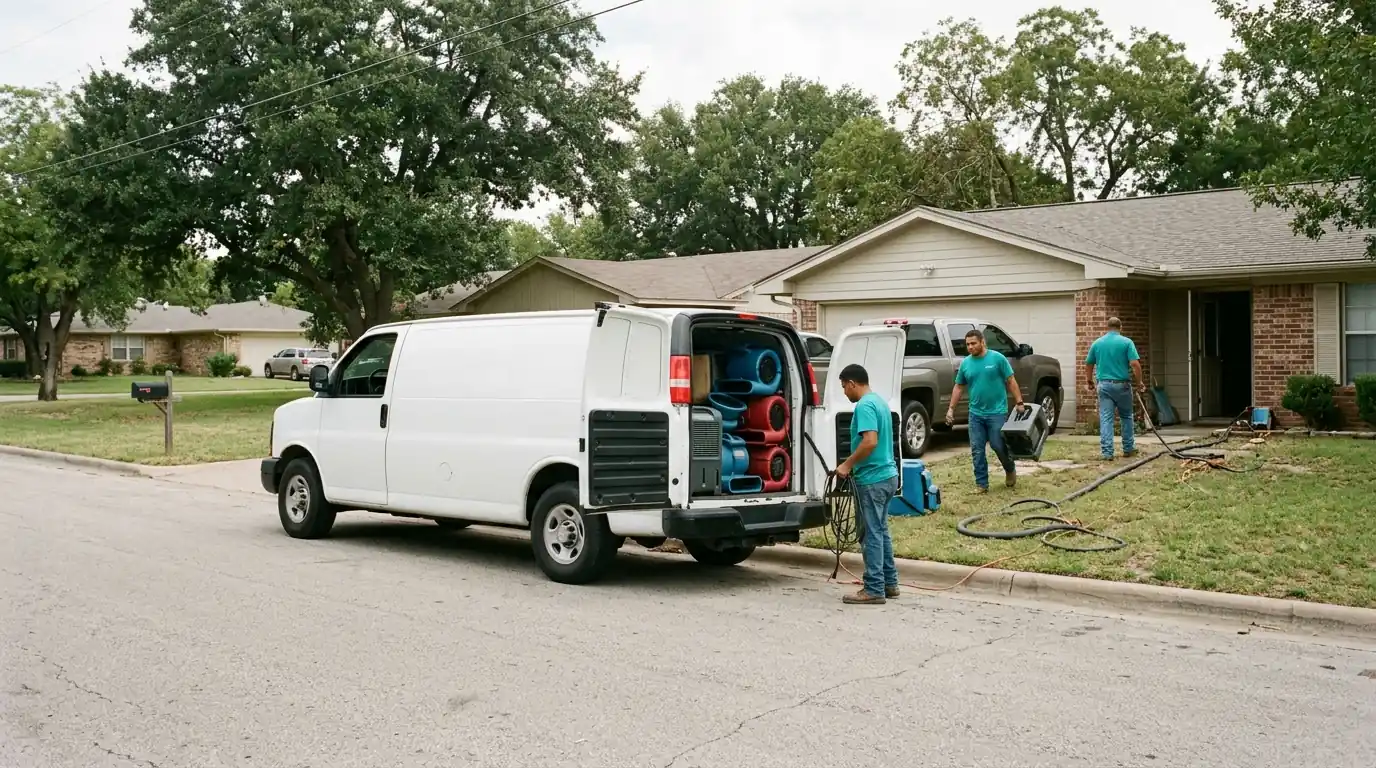
Storm nights can bring many Johnson County calls at once, so we sort them by what is open to the sky. We answer 24/7 and ask whether the roof or a window is breached, whether power is on, and whether anyone is hurt. The truck carries tarps, plywood, extractors and dehumidifiers. Once the house is closed, we pull water and set drying around the wettest rooms.
Johnson County Restoration Questions
Call as soon as it's safe to talk. We can walk you through moving belongings, shutting off power to wet rooms and catching drips. Tarping happens once winds drop enough to work on a roof, and calling early gets your house on the list sooner.
Yes. Standing water in a crawl space keeps the joists and subfloor wet and feeds mold on the wood. We pump it out, pull soaked insulation and torn vapor barrier, then run dehumidifiers under the house until the wood reads dry.
It is. Creek overflow carries soil bacteria, fertilizer and sewage from upstream, so it's treated as Category 3 water. Porous materials it touched usually come out. Hard surfaces get cleaned and treated with antimicrobial before drying.
Drying equipment needs power. Without it, we can still extract standing water, remove wet materials and protect openings, then start full drying once the utility restores service or a safe generator source is set up.
Nearby Areas We Cover
Water, Fire or Storm Damage in Johnson County?
Tell us what happened and where the water or smoke went. We will walk you through the first steps on the phone.
Updated October 2026