Midlothian, TX
Storm and Water Damage Cleanup in Midlothian Homes
Phones answered 24/7 for Midlothian homes and businesses.
Quick answer
Storm and water damage cleanup in Midlothian deals mostly with young houses and fast weather. The city's housing units nearly doubled between 2010 and 2020, and an April 2022 EF-1 tornado touched down nearby. Newer slab homes take wind at the roof and water through the ceilings.
Restoration Work Around Midlothian
Midlothian's new subdivisions share a build style: slab foundations, vinyl plank or laminate floors, drywall on wood framing, and air handlers in the attic. That style dries well when caught early, but water that sits under laminate for a few days swells the core and lifts the seams. We pull the planks in the wet zone, dry the slab and walls, and replace only what failed.
Storm calls in this part of Ellis County mix wind and rain. A downed limb breaks a window, wind peels back shingles, or flash rain overwhelms a yard and pushes water under a back door. We cover openings, pull standing water and set drying in the rooms that took it. When flooring has to come up, flooring replacement follows once the slab tests dry.
Padera Lake and the May 2015 Rain
In May 2015, torrential rain overfilled Padera Lake, about three miles northwest of Midlothian. Cracks in its earthen dam raised fears that U.S. 287 could be flooded with up to 15 feet of water before crews pumped the lake down. The dam held, but the episode shows how much water spring storms can dump on this part of Ellis County. When the ground is already saturated, runoff finds low doorways and garage slabs quickly. That's when we see muddy water across tile and laminate in homes that never flooded before.
What an EF-1 Does to a Newer Home
During an April 2022 storm night, an EF-1 tornado with winds near 90 mph touched down near Midlothian, uprooting trees and tipping an 18-wheeler on U.S. 67. Winds at that level rarely flatten a house, but they lift shingles, tear off ridge vents and drop limbs onto roofs. Each opening lets rain into the attic, where it soaks blown-in insulation and ceiling drywall. Since Midlothian's housing units grew from about 6,100 to nearly 12,000 in ten years, many of these roofs are young but still vulnerable. A new roof is not a hail-proof roof.
Calls We Get From Midlothian
How a Call From Midlothian Runs
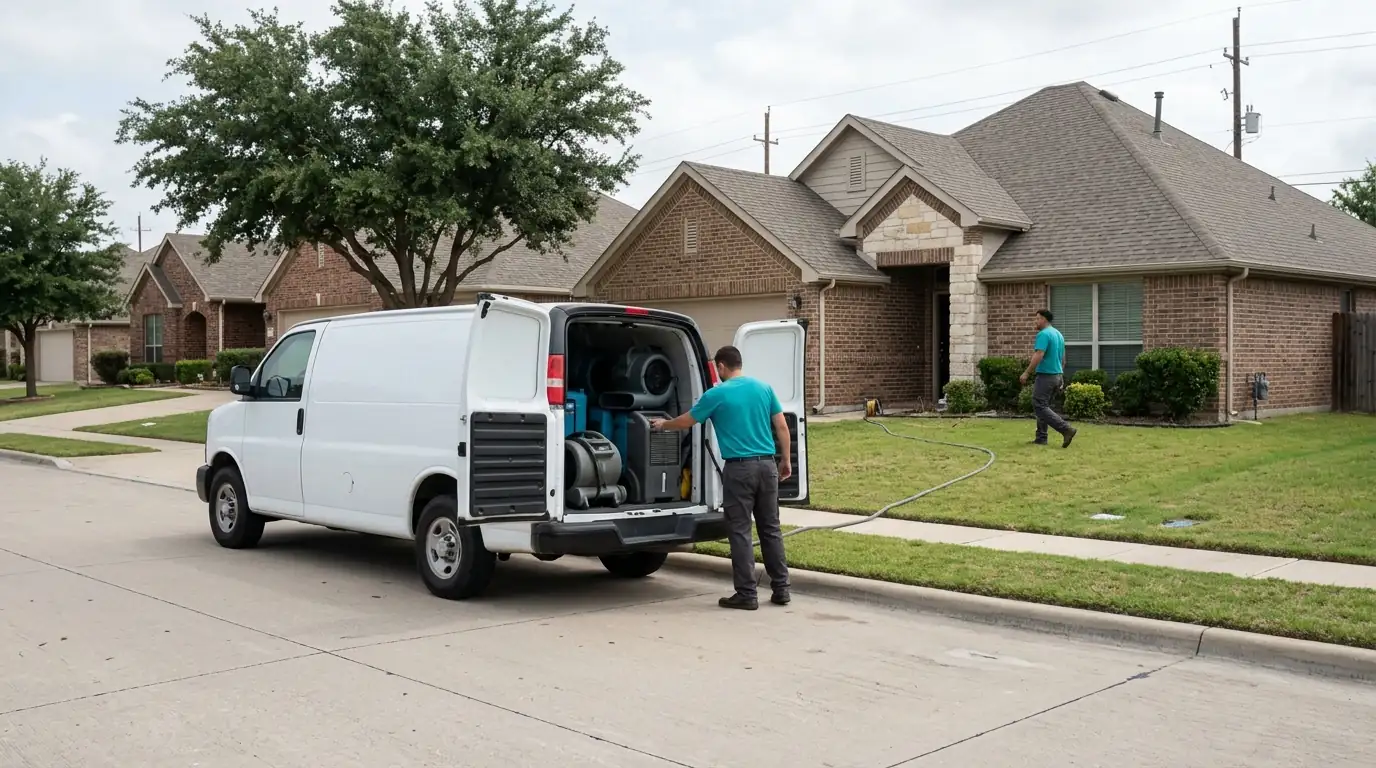
Midlothian storm calls start with what's open: roof, window or door. We answer 24/7 and ask whether water is still entering and where it has spread. We arrive with tarps, plywood, extractors, air movers and dehumidifiers. Once the house is sealed, we pull standing water, lift wet flooring and dry slab and walls together.
Midlothian Restoration Questions
Rarely. Laminate has a fiberboard core that swells when wet and doesn't shrink back. If water sat under it for more than a day, planks usually lift at the seams, so we remove that section, dry the slab and replace it.
Look in the attic with a flashlight after the storm. Light showing through the sheathing, matted insulation or wet rafters all point to an opening. Shingle granules collecting in gutters or torn tabs in the yard are clues too.
No. Runoff crossing a yard picks up soil, fertilizer and bacteria, so it's treated as contaminated. Carpet pad it touched comes out. The slab and hard floors are scrubbed and sprayed with an antimicrobial, then dried.
Newer homes are tightly sealed, so humidity stays inside after a leak. Paper-faced drywall feeds mold when it stays damp more than a day or two, so fast dehumidifying and opened wall bottoms prevent most of it.
Nearby Areas We Cover
Water, Fire or Storm Damage in Midlothian?
Tell us what happened and where the water or smoke went. We will walk you through the first steps on the phone.
Updated October 2026